





























Selecting Industrial Hoses: Costly Mistakes to Avoid
An industrial hose often seems like a simple component — until it starts leaking, cracking, or brings production to a halt. In practice, most problems occur not because of the hose quality itself, but because the hose has been selected incorrectly.
Our specialists highlight three mistakes that occur most often in industrial applications.
Selecting a hose “by eye”
One of the most common situations is when a customer chooses a hose based on its diameter, length, or on what was installed previously. However, different media require completely different solutions.
An industrial hose that is suitable for water may be completely unsuitable for oil, steam, chemicals, or abrasive materials. Even worse, the system may start leaking not because of the hose itself, but because of incorrectly selected gaskets.
In practice, we often see cases where a gasket swells, hardens, or begins to crack, even though the hose itself was theoretically suitable.
“Customers often focus only on the hose diameter or pressure rating, but forget about the medium itself. Chemical compatibility is very often what determines how long the system will operate under real working conditions,” says Marius Vabalas, Sales Manager at UAB Hidrobalt.
To select the right solution, it is important to know:
- what medium will be transported;
- what its temperature will be;
- whether the medium is abrasive;
- what the working pressure is;
- whether the system operates continuously or cyclically.
These details often determine whether a hose will last for years or only for a few months.
The most common hose materials: how they differ and where they are used
One of the most common mistakes in industry is assuming that all hoses are similar. In practice, even hoses that look alike can be made from completely different materials and designed for entirely different working conditions.
Some hoses are better suited for water and steam, others for oil and fuels, while others are designed for aggressive chemicals, solvents, or abrasive materials. Choosing the wrong material is often the reason why a hose begins to swell, harden, crack, delaminate, or wear out quickly.
In practice, problems do not always appear immediately. A system may operate for several weeks or even months, but over time, an unsuitable material can begin to react with the transported medium, temperature, or mechanical load. This can lead to leaks, seepage, connection issues, or even unplanned production downtime.
To make orientation easier, we provide a summary of the most commonly used hose materials and their main properties.
|
Symbol |
Material |
Main properties |
Common applications |
| EPDM | Ethylene propylene diene rubber | Very good resistance to hot water and steam; good resistance to acids, alkalis, salts, ketones, and glycol-based fluids | Food industry, water supply, heating and cooling systems, steam lines, chemical industry |
| EPM | Ethylene propylene rubber | Good resistance to acids, alkalis, salts, industrial alcohols, and glycol solutions | Chemical industry, technical fluid transfer, cooling systems |
| NR | Natural rubber | Very good abrasion resistance and low-temperature resistance | Mining, construction, agriculture, transport of sand, grain, and abrasive materials |
| NBR | Nitrile butadiene rubber | Very good resistance to oils, greases, and petroleum products | Fuel systems, automotive industry, hydraulics, lubrication systems |
| CR | Chloroprene rubber (neoprene) | Good resistance to ozone, UV radiation, and weathering; flame-retardant | Outdoor equipment, refrigeration systems, marine industry, transport |
| SBR | Styrene-butadiene rubber | Good abrasion resistance; cost-effective material | General industry, construction, transport of cement, sand, and bulk materials |
| FPM / FKM | Fluoroelastomer rubber (Viton) | Very good resistance to more aggressive chemicals, fuels, and high temperatures | Chemical industry, oil and gas sector, high-temperature processes |
| UPE / UHMWPE | Ultra-high-molecular-weight polyethylene | Very good chemical resistance to most acids and alkalis | Chemical, pharmaceutical, and food industries |
| PTFE | Polytetrafluoroethylene (Teflon) | Excellent chemical and temperature resistance | Chemical, pharmaceutical, and food industries, laboratories |
| PVC | Polyvinyl chloride | Cost-effective choice; good resistance to certain acid and alkali solutions | Water supply, drainage, ventilation, agriculture |
| PU | Polyurethane | Very good resistance to wear and abrasive particles | Wood, furniture, and plastics industries, dust extraction systems |
| PA | Polyamide (nylon) | Good resistance to solvents, paints, varnishes, and adhesives | Pneumatics, paint and varnish industry, automotive sector |
It is important to understand that truly universal hoses practically do not exist. Even if a material is theoretically suitable for a specific medium, the final decision is still determined by the entire working environment: temperature, pressure, medium concentration, operating cycles, connections, and mechanical load.
“Customers often look for a universal solution, but in practice, every medium and every working condition has different requirements. Sometimes even a small difference in temperature or chemical composition can have a significant impact on the service life of a hose,” says Marius Vabalas, Sales Manager at UAB Hidrobalt.
For this reason, professional industrial hose selection helps not only to ensure system tightness and safety, but also to reduce the risk of downtime, failures, and unplanned repair work.
Selecting a hose without evaluating real working conditions
Another common mistake is choosing a hose based on catalogue data without considering how it will operate in the actual working environment.
In industry, hoses rarely work under ideal conditions. They are bent, pulled, move together with equipment, rub against surfaces, and are exposed to vibration, temperature fluctuations, oil, dirt, or UV radiation.
For this reason, pressure rating or diameter alone is often not enough.
If a hose will operate in a moving system, its flexibility and minimum bending radius must be evaluated. If there is a lot of friction or mechanical contact in the environment, a more resistant outer layer or additional protection is required. In outdoor conditions, weather resistance is important, while in high-temperature areas, the right material and hose construction are essential.
Pressure surges also often cause problems in practice. A system may operate steadily most of the time, but short-term pressure peaks place significant stress on the hose. If the hose has been selected “on the limit”, its service life is significantly reduced.
“A catalogue shows technical limits, but under real conditions a hose is affected by many more factors. It is necessary to understand how it will be used in practice — whether it will move, whether it will be bent, and what mechanical and temperature impact it will experience. Only then can a reliable solution be selected,” says Marius Vabalas, Sales Manager at UAB Hidrobalt.
Insufficient attention to connections and installation
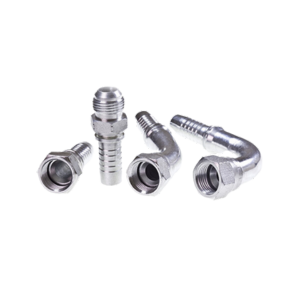
Even a correctly selected hose will not guarantee reliable operation if the wrong fittings are used or if the system is installed incorrectly.
In practice, a large share of problems occurs specifically at the connection points: due to incorrectly selected fittings, gaskets, excessive bending, twisting, or uneven loading.
Such mistakes often lead to:
- leaks;
- vibration;
- faster wear;
- pressure losses;
- hose damage at the connection points.
Another often underestimated topic is preventive maintenance. Cracks, swelling, hardening, worn surfaces, or seepage at connection points usually do not appear suddenly. The system often starts “warning” about the problem much earlier.
Noticing signs of wear in time helps prevent more serious failures, downtime, or even equipment damage.
“In practice, we often see that the problem is not caused by the hose itself, but by the complete assembly: incorrect fittings, gaskets, installation angle, or lack of maintenance. A hose must be evaluated as part of the entire system,” emphasises Marius Vabalas.
How to reduce the risk of mistakes
When selecting an industrial hose, it is not enough to consider only its diameter or length. A reliable solution is possible only when the entire working environment is evaluated: the transported medium, temperature, pressure, intensity of movement, environmental impact, connections, installation conditions, and operating mode.
The more accurately real working conditions are evaluated, the easier it is to select a solution that will last longer and reduce the risk of failures.
In industry, even a short downtime can mean additional costs, production disruptions, or occupational safety issues. For this reason, professional hose selection often helps save much more than the cost of the hose itself.
UAB Hidrobalt specialists help evaluate not only technical parameters, but also real operating conditions. Taking into account the medium, temperature, pressure, connections, installation environment, and operating mode, we help select a suitable and reliable solution for each specific application.