





























Layflat hoses: a versatile solution for water supply in agriculture, construction and industry

What are Layflat casings?
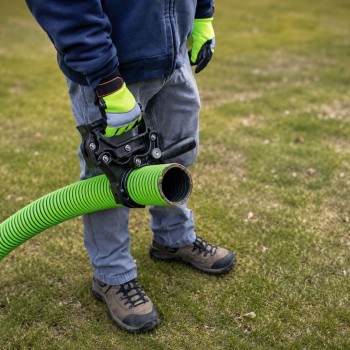
Layflat hoses are flat, flexible hoses made of PVC or other synthetic materials that expand under pressure and compress when not in use. They are often reinforced with polyester mesh for extra strength and pressure resistance. Their design makes them light, compact and easy to transport.
Technical characteristics
Flat water hoses are available in a wide range of diameters and pressure classes to meet different needs. For example, a 102 mm diameter hose can withstand a working pressure of up to 6 bar and a burst pressure of 12 bar. It has an operating temperature range of -10°C to +60°C and its PVC and polyester yarn construction ensures strength and durability.
An important difference is the higher operating pressure!
Layflat hoses on the market often differ in their working pressure class, with products available for pressures as low as 3, 4 or 5 bar. However, this may not be sufficient for more intensive use or in situations where the water supply system is operating at higher pressures. The Layflat hoses we supply have a working pressure as low as 6 bar and a limit pressure three times higher. This means greater reliability, longer service life and less risk of hose rupture - especially with frequent on/off cycles or sudden pressure surges. When you choose a 6 bar hose, you are investing in safety, efficiency and resilience under real working conditions.

Single-component and double-component hoses - which to choose?
Layflat hoses are not only differentiated according to the working pressure or the application, but also according to the type of construction - there are single-component hoses and two-component (double-layer) hoses. Both have their advantages, but it is important to understand which type is more suitable for a particular application.
Single-component hoses
Single component hoses are made from a single solid mass of PVC or other material into which a reinforcing layer (polyester mesh) is fully embedded. This solution ensures:
- Ideal adhesion (bonding) of the layers
- resistance to delamination that may occur during use
- durability, even under pressure or cuts.
This is particularly important when the hose is used in irrigation systems where nozzles or drip attachments are frequently connected. At the point of insertion, water pressure does not penetrate between the layers, thus ensuring a reliable and tear-free hose life.
Recommended for: irrigation, drip systems, transport of water and weak chemicals.
Bicomponent (double-layer) hoses
Binary hoses consist of an inner and an outer layer with a reinforcing layer sandwiched between them. This hose construction allows the combination of different materials to suit specific conditions:
- the inner layer can be moulded from a thermoplastic rubber compound resistant to abrasion - suitable for transporting sand, sludge or other more aggressive fluids;
- the outer layer is often made of PVC or PU, resistant to UV and external influences.
However, these hoses are not recommended for bayonet nozzles - if water enters between the layers through the inner layer, it can cause internal pressure and damage the hose.
Recommended for: conveying abrasive materials.

Main advantages of plate hoses
1. Easy transport and storage
Layflat hoses are lightweight and compress to a flat shape, making them easy to transport and store. This is particularly important when moving equipment between different workstations or storing it in limited space.
2. Quick installation and removal
Thanks to their flexibility and length, Layflat hoses can be quickly unwound and rolled up, saving time and labour. This allows an efficient response to changing working conditions.
3. Resistance to environmental factors
These hoses are UV, chemical and abrasion resistant and can therefore be used in a wide range of weather conditions and challenging environments. They are also resistant to corrosion and micro-organisms.
4. Cost-effective solution
Layflat hoses have a long service life and low operating costs. They are easy to maintain and their reduced weight and flexibility reduce transport and labour costs.

Applicable in various fields
In agriculture
Layflat hoses are widely used in irrigation systems, fertiliser and pesticide delivery. Their flexibility allows easy adaptation to different field conditions and their resistance to chemicals ensures a long service life.
In industry
In industrial processes, Layflat hoses are used for fluid transport, cooling systems and other applications where a flexible and reliable solution is needed. Their resistance to chemicals and high temperatures ensures safe and efficient operation.
In construction
On construction sites, Layflat hoses are used for water supply, drainage and concrete work. Their lightweight and quick installation allows efficient management of water flows and adaptation to changing working conditions.
Layflat hoses are a versatile, reliable and cost-effective solution for a wide range of industries. Their flexibility, lightness and resistance to environmental influences make them an effective solution for water supply and fluid transport. If you are looking for an efficient solution for your farm, construction site or industrial plant, Layflat hoses are the perfect choice.
Detailed specifications for Layflat hoses on the product page Layflat hoses